
Two Different Machines Produce These Two Outcomes
It's an easy assumption to carry over from a decade of Amazon SEO: rank well, and the rest follows. That assumption held up reasonably well when a shopper's own eyes did the final comparison on the results page. It doesn't hold up the same way once Amazon's AI — Alexa for Shopping (formerly Rufus) — is doing that comparison instead.
Organic rank comes out of Amazon's search index — a system built to answer "which listings match this keyword query, and in what order." Recommendation Share comes out of a completely separate process: an AI reading the actual content of a small set of candidate listings and deciding which one best answers a specific, often conversational question. These aren't two measurements of the same underlying thing. They're outputs of two different systems, evaluated against two different inputs. See how Amazon's AI decides which product to recommend for the mechanics of that second process — what it's actually weighing when it reads a listing.
Treating a strong rank as proof of a strong Recommendation Share is the single biggest carryover error of this transition — and it's an easy one to make, because for years the two really did move together closely enough that the difference didn't matter.
Part of why the error is so easy to make is that both systems draw on overlapping signals without producing overlapping outcomes. A well-optimized listing tends to do reasonably well on both fronts, which is exactly why sellers with strong rank often assume the recommendation side is automatically covered too. It usually isn't automatic — it's a separate, parallel result of the same underlying content, and it can diverge from rank in either direction.
What the Data Shows
The numbers below come from a real, cross-category measurement, not a hypothetical — 150 products across 30 niches in 6 categories, published in full in The State of AI Recommendations on Amazon (Keoxs, Q3 2026):
That figure alone is the headline of this article. If the top-ranked listing were reliably the AI's pick, this number would sit close to 100%. The gap between that number and 100% is, in a real sense, the size of the opportunity (or the risk) this whole cluster is about.
This is the flip side of the same finding: a lower-ranked product isn't just occasionally squeezing out a win — in a meaningful share of niches, it's the one the AI recommends most often, out of all 5 products compared.
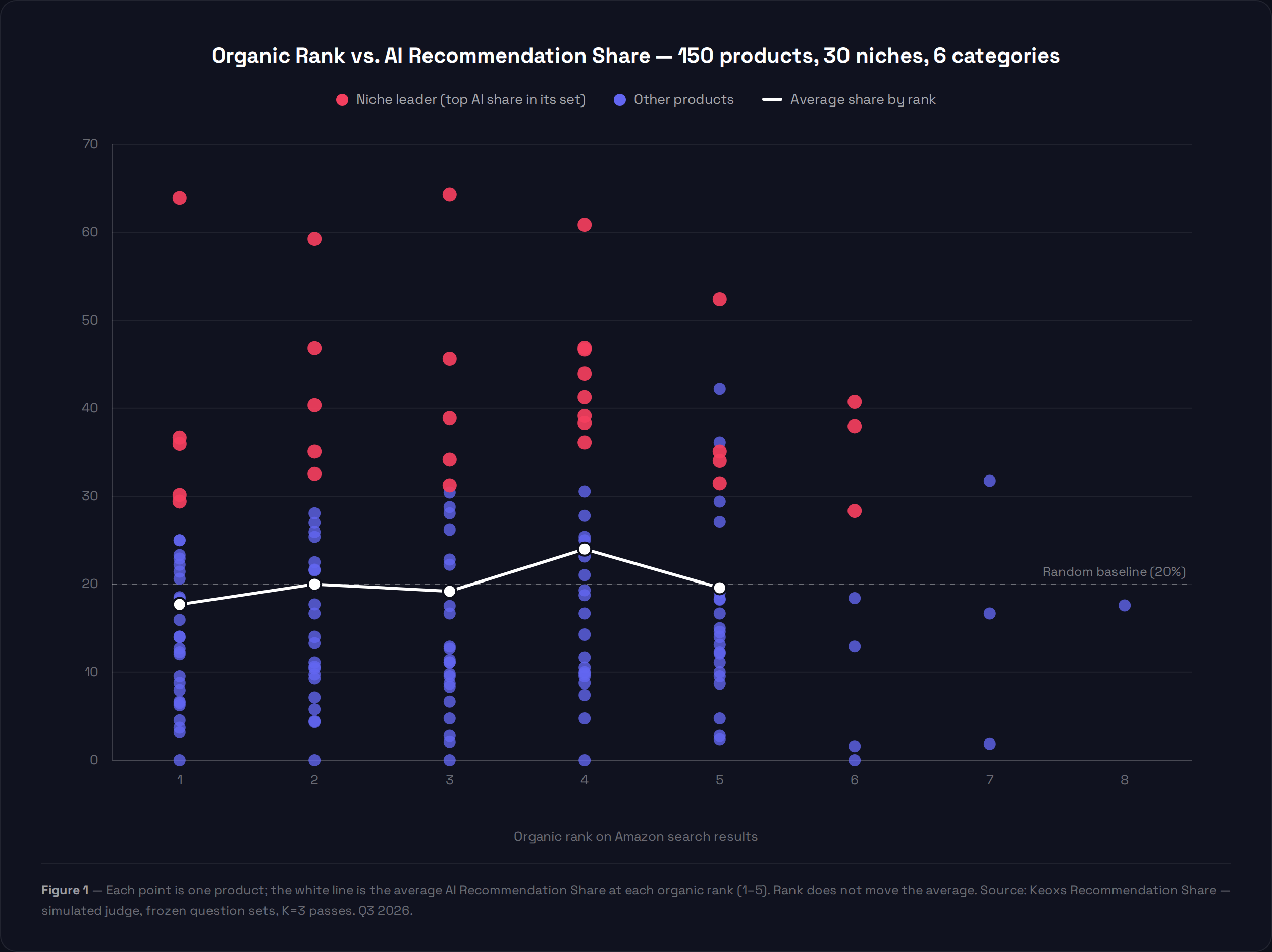
Why Divergence Happens
Three mechanisms explain most of the gap between a strong rank and a weak Recommendation Share:
Keyword-optimized but question-blind content. A listing can be dense with the right keywords — enough to rank well — while never actually answering the specific questions a shopper might ask. A dog supplement listing that repeats "joint support" a dozen times but never says whether it's safe for puppies loses every "is this safe for a puppy" question, no matter how it ranks.
Unverifiable superlatives. "The best joint supplement for active dogs" reads fine to a human skimming a results page. An AI comparing it against a competitor's "clinically-dosed glucosamine, 500mg per serving, vet-formulated for dogs over 20 lbs" has nothing to weigh the first claim against — it's not evidence, just assertion.
Positioning mismatch. A listing priced and worded like a budget option, but making premium-sounding claims (or the reverse), reads as internally inconsistent. An AI comparing it to a competitor whose price and language agree has a harder time trusting the mismatched one's claims at face value.
All three mechanisms share something in common: none of them show up in a rank tracker. A rank tracker tells you a position number changed or held steady; it has no way to tell you that your bullets never answer the "safe for puppies" question, or that your best claim reads as an unverifiable superlative next to a competitor's specific one. That's precisely the blind spot Recommendation Share is built to close — it's the difference between knowing you're in the room and knowing why you were, or weren't, the one chosen.
When Rank and Share DO Align
None of this means rank is meaningless or that top-ranked listings are usually weak. In a large share of cases, the listing that ranks well also has the specific, well-covered content that wins AI recommendations — because the seller behind it did both jobs well. Divergence is a real, measurable pattern in the data above; it isn't a universal law that rank and recommendations always disagree.
The honest takeaway is narrower and more useful than "rank doesn't matter": rank and Recommendation Share are correlated but not identical, and the size of the gap between them is worth knowing for your own specific product and niche — not assumed from either extreme.
This is also why a measurement on your own product is more useful than a category-wide average. The data above describes a pattern across the 30 niches measured — it tells you divergence is common enough to check for, not what your own gap looks like. A listing that happens to already cover its category's most-asked questions in specific, verifiable language may show very little divergence at all; one that's never been looked at through this lens might show a great deal.
What to Do With This
Two practical moves follow directly from the data:
- Check both metrics, not just one. Rank tells you whether you're in the room. Recommendation Share tells you whether you're the one chosen once you're there. A strong rank with a weak share is a content problem, not a ranking problem — and the fix is different from anything PPC or keyword work can address.
- Treat rank as reach and Recommendation Share as choice. They answer different questions ("how many shoppers see me?" vs. "how often am I the one picked?") and both are worth tracking on an ongoing basis, not as a one-time check.
See Recommendation Share for the full definition and methodology behind the metric referenced throughout this article.
The comparison in this article is grounded in Amazon's published research (COSMO, SIGMOD 2024; SPN Shopping Agent, WSDM 2025), adapted by Keoxs — not a description of Amazon's live, confirmed ranking or recommendation logic. The measurements above come from Keoxs's own Recommendation Share reports run against real, named products in the category studied.
| Dimension | Organic rank | Recommendation Share |
|---|---|---|
| What it measures | Where a listing appears in search results for a keyword | How often an AI recommends the product over named competitors |
| Who does the comparing | The shopper, scanning a results page | The AI, comparing content directly |
| What moves it | Keyword match, conversion rate, PPC, similar signals | Content coverage of the question, verifiable claims, review corroboration |
| How you check it | Rank trackers, Seller Central | A Recommendation Share report |